Jun 01, 2026
A GeoSure Risk Intelligence White Paper
Prepared for GeoSure’s GSOC Partner Community | New York, NY | June 2026
Close protection has always been a discipline of advance work. The detail leader who knows the route, the venue, the local rhythm, and the threat picture before the principal arrives is the one who keeps the principal safe. The tradecraft hasn’t changed in fifty years. The tools have.
The change underway is not “more data.” Every Global Security Operations Center (GSOC) already has more data than it can read. The hard part — and the part that has only recently become solvable — is turning the world’s flood of raw reporting into a usable picture: reading thousands of articles a day in more than 150 languages, watching hundreds of channels across the messaging apps that matter locally, and connecting a road closure to a planned protest to a threat posted six months ago. Then producing a brief a detail leader can act on, in plain English, in under a minute.
That synthesis layer is what GeoSure built. We call it GRO — the GeoSure Global Risk Observatory. It runs continuously: it reads the world’s public reporting, pins each item to the neighborhood it happened in, combines it with trusted ground-truth data, and hands the result to a series of AI assistants that can answer questions about it on demand.
The discipline that comes out of this — call it AI tradecraft — is not a replacement for trained people in the field. It is a permanent, tireless intelligence layer behind every advance and every movement. It shifts the unit of attention from “the city we’re going to” to “the small area around the principal in the next 60 minutes.” And it can be combined with the data your security program already owns — access control, corporate travel, vehicle tracking, existing intel subscriptions — into one coherent picture. The technology to do this exists today. What’s required is implementation.
This paper describes how that layer works, what it can and cannot do today, and how it fits the protective cycle for corporate executives and the principals a security program protects. It is grounded in what GRO actually does in production — with honest limits.
The classic EP intelligence model rests on three tiers, each with a known limitation:
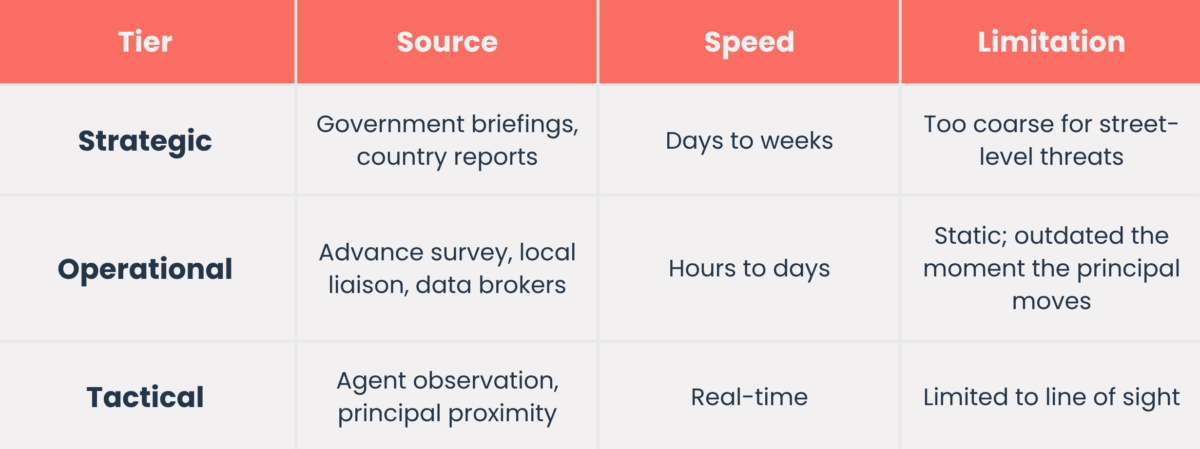
Between operational and tactical sits a 30-to-180-minute window where modern threats now organize — protests forming on messaging apps, paparazzi tipped off on social video, opportunistic crowds spawning in group chats, road closures cascading through local social media. Hostile surveillance patterns often show up in foreign-language posts before they ever appear in a route survey. Civil disturbance, infrastructure failure, transit strikes, and weather can all shift the picture during a movement.
A traditional EP intelligence analyst can fill some of this gap — but typically for one principal, in one language, for a few hours a day. That doesn’t scale for a Fortune 500 with executives moving across 30 countries, or for a security program covering multiple principals, offices, and dozens of annual destinations.
This is the gap AI tradecraft closes.
We define AI tradecraft as the disciplined use of AI assistants that can independently look things up, reason about what they find, and produce a usable written output — applied to the protective intelligence cycle.
Three things separate this from “we use ChatGPT in the GSOC”:
1. How Is Curated Security Intelligence Different From General Web Search?
A general chatbot searches Google. An AI tradecraft system queries a curated, scored, geographically organized library of safety, conflict, news, and open-source data — refreshed continuously and pinned to the neighborhood, not just the city.
2. Can an AI Assistant Replace a Security Analyst's Dashboard?
Instead of you pulling up a dashboard and interpreting it, a capable AI assistant can do the legwork itself: look up a location, pull its safety scores, check live news around it, compare it to historical patterns, and draft a brief. The detail leader doesn’t query a database — the detail leader asks a question, and the assistant does the work.
3. How Often Should Executive Protection Teams Monitor Threat Intelligence?
A good analyst checks the picture every few hours. An AI assistant checks it every few minutes — on every facility, every residence, and every active principal location at once, in every relevant local language. When the picture changes in a way that matters, the GSOC is told. When nothing changes, no one is interrupted.
This is not a future state. It is in production at GeoSure today — serving an Asia-Pacific travel platform with millions of monthly users, and a corporate pilot pipeline monitoring hundreds of office and meeting locations worldwide in real time.
GeoSure spent twelve years building the underlying data foundation and the past year building the AI layer that reasons over it. The system that holds it together is GRO — the GeoSure Global Risk Observatory. It has four parts that matter to a protection program: a geographic foundation, a continuous reading-and-synthesis pipeline, an open-source layer that respects how the world actually posts, and a way to fold in your own internal data.
3.1 Why Neighborhood-Level Data Matters More Than City-Level Data for Executive Protection
The world is not made of cities. It is made of neighborhoods, corridors, blocks, and addresses. GRO divides the populated surface of the planet into roughly five million small cells, each about three-quarters of a square kilometer — about the size of a city neighborhood. Covering over 1M cities in 200+ countries.
Every cell carries a safety score on a 1-to-100 scale across six separate dimensions — physical violence, theft, health and medical, political freedoms, women’s safety, and a day-versus-night difference — rather than collapsing everything into a single number. Behind each cell sit authoritative inputs: verified ground-truth event data, global governance and prosperity indices, national and local crime statistics where they exist, and a database of over 71M points of interest.
For the protection team, this means:
3.2 How Does Real-Time Safety Intelligence Get Collected and Verified?
GRO continuously reads the world’s publicly reported events. The volumes are intentionally large, but the volume is not the point. The point is what happens between collection and the desk of the protection director.
On the input side, GRO pulls from over 10,000 curated news feeds, commercial newswires, and a real-time global event stream — on the order of 100,000 articles a day, across more than 150 languages, in effectively every country.
Raw collection is the cheap part. The valuable part is what GRO does next:
The result is a few thousand fully-located, de-duplicated, classified items a day — each tied to a neighborhood and ready for a person or an assistant to use. For live sources, the time from original publication to a located event in GRO is measured in minutes, not hours. This live layer is paired with trusted historical ground-truth data to provide both the current picture and the longer-term pattern.
3.3 Why Does Threat Monitoring Need to Change by Region and Language?
This is the part that surprises new corporate clients. Open-source intelligence is not one discipline — it is radically different by region. Where people live determines which platforms they post to about a road closure, a protest, a celebrity sighting, or a fight outside a bar.
A program built only around X and Reddit is functionally blind in two-thirds of the world. One that adds TikTok but ignores Telegram will miss the meaningful workforce signals in oil-and-gas operations across the Caspian, North Africa, and the Middle East.
3.4 Can Security Intelligence Platforms Integrate With Existing Access Control and Travel Systems?
This is the part most prospective customers don’t expect. A corporate GSOC already runs on a stack of internal systems — none of which talk to each other:
The access-control system sees badge swipes. The travel manager sees itineraries. The analyst sees public news. None of them sees the combined picture — and the combined picture is what determines whether a threat is caught before it becomes an incident.
GRO is designed to be the layer that pulls these together. The same system that reads public news and open-source data can read your private feeds — under your access controls, on your compliance terms, inside your own environment — and reason across both the public and private picture together.
Importantly, this is wired in carefully and conservatively. For access control, GRO consumes badge events — not personal identity details beyond what you choose to forward. For travel, itineraries automatically switch on monitoring for the relevant locations. For vehicle tracking, live position updates let alerts re-score against the route being driven.
The technology to do all of this exists today. There is no missing science. What’s required is implementation — building the connectors and deploying the system in your environment under your governance. That is an engineering engagement of weeks to months, not a flip-the-switch purchase, and we are clear about that scope from the first conversation. The line stays exactly where it should: public sources follow public-source rules; your private data stays under your control, on your compliance regime, inside your boundary, with full audit logging.
Close protection has always been a discipline of advance work. The discipline has not changed. The tools have.
For the first time, the intelligence layer behind a protection program can be persistent, multilingual, neighborhood-resolved, integrated with your existing systems, and fully audit-logged — without growing the headcount of the GSOC. The model shifts the unit of attention from the city to the neighborhood, from the daily brief to the continuous alert, and from the analyst in front of a screen to the assistant watching the world.
GRO and the broader GeoSure platform deliver this in production today, with honest limits about what is not yet covered. The capability is not science fiction. It is implementation. We share this paper so that the corporate security community can understand what is now possible — and what to demand from any vendor claiming to deliver it.
We welcome the conversation.
About GeoSure Risk Intelligence and GRO
GeoSure has spent twelve years building the geographic risk-scoring foundation that anchors the platform, and the last year building the AI layer that reasons over it. GRO — the GeoSure Global Risk Observatory — is the always-on engine at the heart of the platform: continuously monitoring the world’s news, events, and open-source signals, locating them down to the neighborhood, and exposing the result to AI assistants and to integrated customer systems. The platform serves customers including a major Asia-Pacific travel platform and a growing pipeline of Fortune 500 GSOCs.
For inquiries: contact the GeoSure Risk Intelligence team at info@geosure.ai, or GeoSure CSO Daniel Madden directly at dpm@geosure.ai.
This paper describes capabilities in production as of June 2026 and capabilities in active development. Forward-looking statements are identified as such.